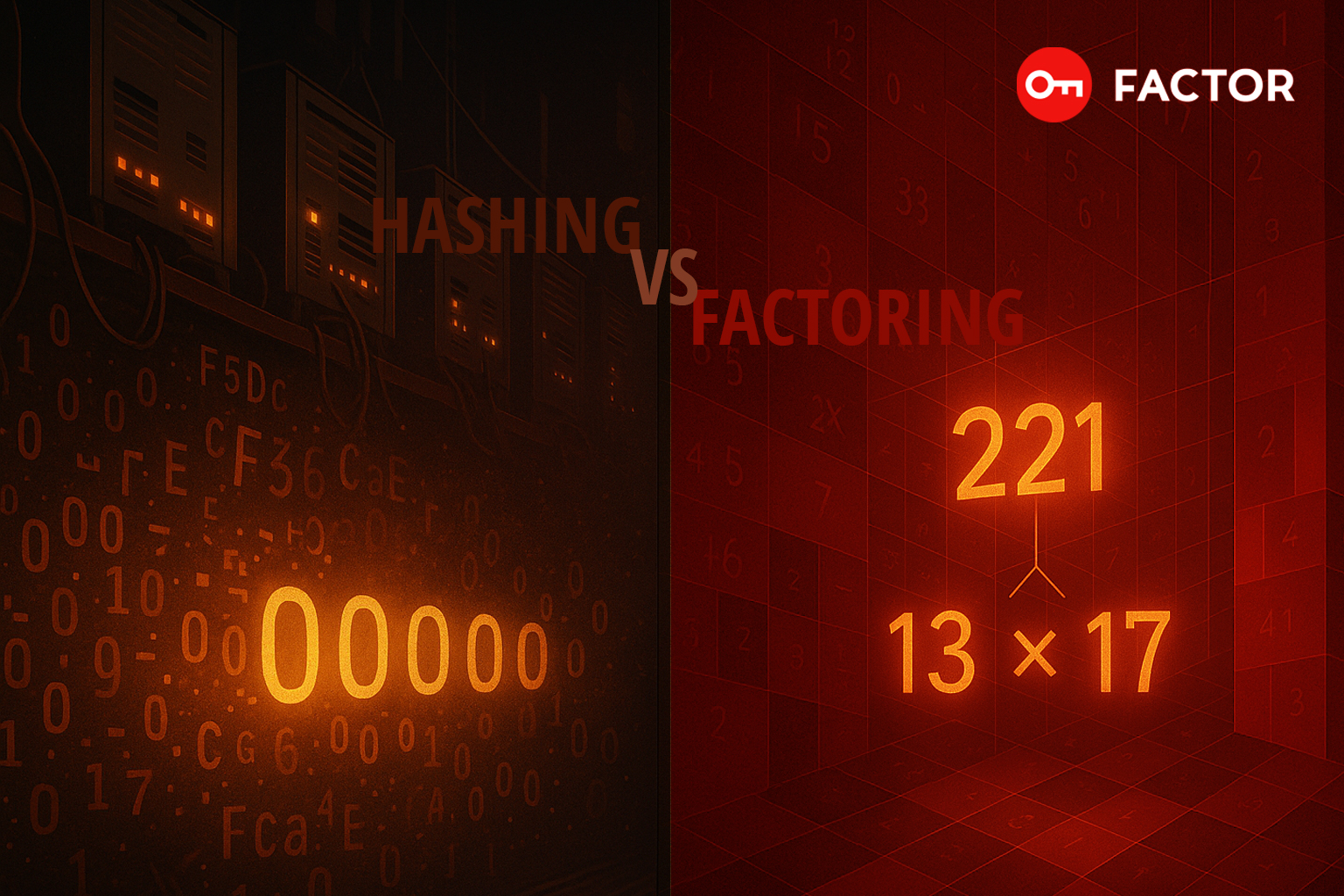
Rethinking Proof-of-Work in the Age of Useful Computation
Factor’s Proof-of-Work is Unique
For more than a decade, every Proof-of-Work blockchain has followed the pattern established by Bitcoin: use a hashing algorithm such as SHA-256, scrypt, Ethash, RandomX, or Heavyhash and race to find a hash below a network-defined target.
That model became so familiar that “hashing” became shorthand for Proof-of-Work itself.
But hashing isn’t the essence of Proof-of-Work. Work is.
Factor is the first live blockchain to prove that the “work” can be something else entirely: real, mathematically useful computation.
Historical Context: How “Hash” Became Synonymous with Proof-of-Work
When Satoshi Nakamoto built Bitcoin in 2008, he used SHA-256 hashing as a probabilistic race—easy to verify, hard to fake, and cryptographically secure. It worked so well that the industry assumed Proof-of-Work and hashing were one and the same.
From then on:
Bitcoin used SHA-256
Litecoin used scrypt
Monero used RandomX
Kaspa created Heavyhash
Different tools, same pattern: burn energy to find a random hash that meets a target.
This design secures networks but produces no secondary value. Every solved hash is discarded the moment a new block is found.
The Factor Break
Factor rejects that waste. Its Proof-of-Work doesn’t hash, it factors.
Each block challenge presents a large composite number, n = p × q.
Miners race to discover its two hidden primes using the General Number Field Sieve (GNFS), the fastest known classical algorithm for integer factorization.
Instead of random hashes, the network produces verified mathematical results.
The computation itself means something.
Definition: GNFS (General Number Field Sieve)
The General Number Field Sieve is a number-theoretic algorithm used in cryptography and research to break large RSA keys. It relies on modular arithmetic, sieving, and linear algebra to find the two prime factors of very large semiprimes.
In plain terms, it is the most efficient classical method for finding the hidden primes behind encryption-grade numbers—a task considered computationally monumental.
How GNFS Works
Polynomial Selection – A polynomial defining a number field is chosen for the target semiprime.
Sieving Phase – Large ranges of integers are searched to find relations that share smooth factors.
Matrix Step – A massive, sparse matrix of these relations is assembled and solved using linear algebra.
Square-Root Step – The prime factors are extracted from the matrix solution.
Each phase requires significant computational work and coordination. Verification is instant and absolute because p × q must equal n.
Why It Matters to Factor
This design changes everything.
Security is still guaranteed by energy expenditure.
Verification is instant and unforgeable.
The output is mathematically useful.
Factor’s Proof-of-Work is not just secure, it is productive.
Every mined block contributes to a growing dataset of factorizations that can support scientific, academic, and cryptographic research.
It turns mining from wasted heat into Useful Proof-of-Work, the first practical implementation of an idea long discussed but never realized.
How GNFS Fits Factor’s Design
In Factor’s architecture:
The consensus mechanism is Proof-of-Work.
The algorithm is called Factor.
The computational engine is GNFS.
Difficulty adjusts by scaling the composite size, for example from 512-bit to 1024-bit or 2048-bit, keeping block times stable while ensuring the work remains verifiably expensive.
This creates a balanced network where computational cost and reward follow the same feedback loop as traditional Proof-of-Work systems, only the work itself is different.
What This Means for User Groups
Miners
Hardware contributes to verified mathematical discovery instead of random hashes. Mining remains competitive but meaningful. Mining that matters.
Academics and Researchers
Factor acts as a distributed factoring engine, generating data relevant to cryptography, number theory, and post-quantum studies.
Enterprises and Governments
Factor demonstrates a new model: Proof-of-Work that generates public good—secure consensus with measurable computational value.
Developers
Factor’s model opens the door for an entirely new class of Useful Workchains that secure themselves by performing computations that already matter.
Closing Thought
The founder of Factor summarized it best:
“To be pedantic, it’s the PoW algorithm. Since Satoshi chose hashing, everyone thinks it can only be hashing and assumes the PoW algo should be called a ‘hashing algorithm,’ but no, it’s a PoW algorithm, which need not be hashing.”
Factor proves that point.
It doesn’t hash, it factors.
And that single distinction redefines what work can mean in the blockchain world.